AI’s Impact on Creative Services and 2D Graphics
Posted on : Dec 09, 2025
The creative industry is experiencing its most seismic shift since the advent of the digital camera. Generative Artificial Intelligence (AI) has shattered the traditional barriers of content creation, transforming what was once a slow, manual craft into a high-speed, scalable, and data-driven discipline.
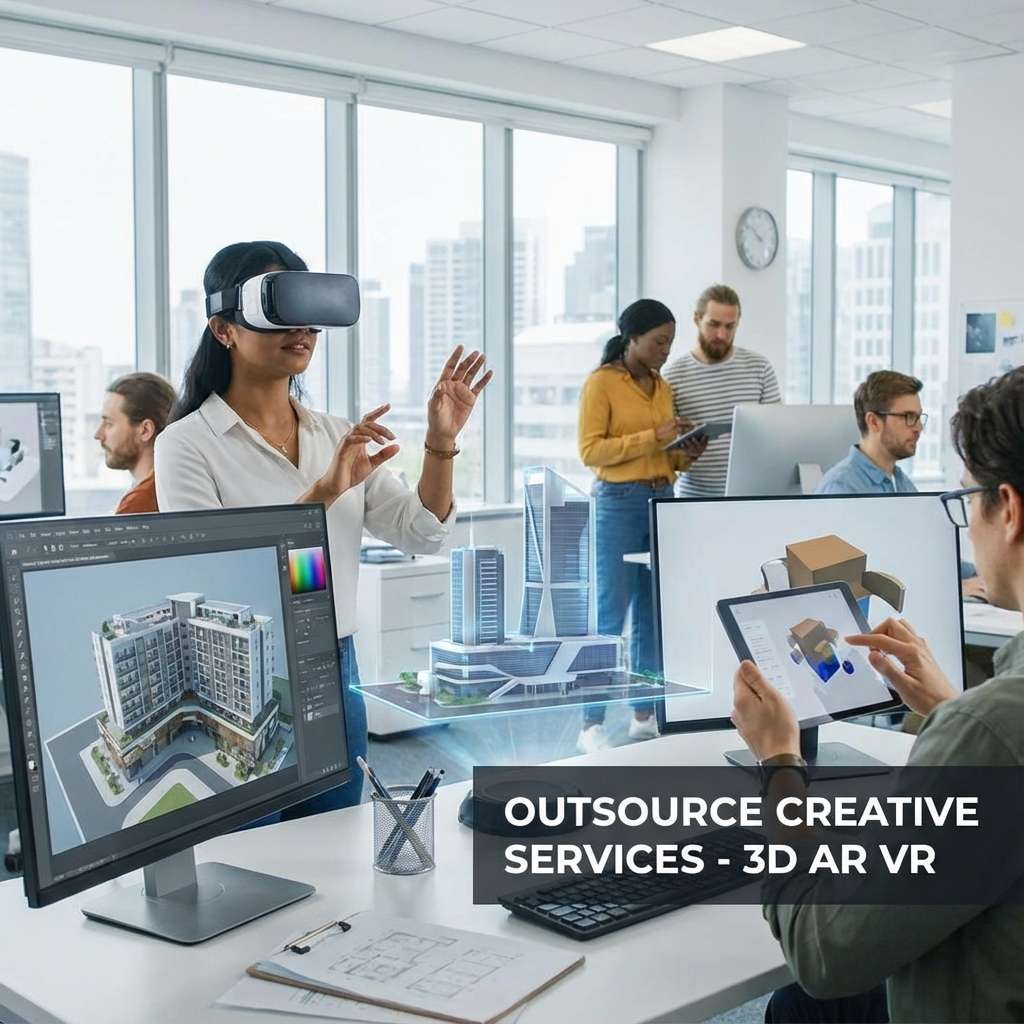
For businesses relying on vast quantities of high-quality visual assets—from personalized marketing banners to intricate character designs for interactive media—the question is no longer if AI will be integrated, but how it will redefine their relationships with their Outsource creative services partners.
The future of Outsource creative works is not a competition between human and machine; it is a collaborative partnership where AI handles the speed and scale, and human creativity provides the context, emotional depth, and strategic direction. This transformation is pivotal across the spectrum of visual communication, particularly within 2D Services, 2D Graphics & Illustration, VFX, and the emerging field of Augmented Reality – Virtual Reality modeling.
This blog explores the fundamental shifts in the role of creative outsourcing, focusing on how AI and human expertise are merging to create a powerful, intelligent content engine.
I. Automation of Repetition: AI as the Production Engine for 2D Services
The most immediate and significant impact of AI on 2D Services lies in the automation of the tedious, time-consuming, and repetitive tasks that often consume up to 70% of a creative professional’s day.
1. Hyper-Velocity Content Production and Variation 📈
Modern marketing demands hyper-personalized content. A single campaign may require dozens of variations of a banner ad or social media post, optimized for different demographics, platforms, and calls-to-action. Manually creating these variants is an impossible logistical bottleneck.
- The AI-Driven Pipeline: Outsource creative design services now leverage AI tools (like generative fill and style transfer) to take one core, human-designed asset and instantly generate hundreds of on-brand variations. AI automates resizing, cropping, minor compositional changes, and color palette adjustments while ensuring brand consistency. This allows brands to achieve personalization at an enterprise scale, dramatically reducing the time-to-market for campaigns.
2. Streamlining 2D Graphics & Illustration Workflows ✨
The foundation of great illustration and graphic design involves countless hours spent on tasks like rotoscoping (isolating objects in video frame-by-frame), creating multiple states of a character, or generating seamless patterns and backgrounds.
- Augmentation, Not Replacement: AI tools are now highly proficient at these technical tasks. For instance, AI-powered rotoscoping can isolate a moving subject with pixel-perfect accuracy in seconds, freeing the human 2D Graphics & Illustration artist to focus on the expressive, narrative, and high-value artistic aspects. An outsourced partner equipped with this technology can deliver finalized 2D Services and illustrations with unprecedented speed and technical quality.
3. Intelligent Image Cleanup and Retouching 📸
Basic image manipulation, color correction, and removal of unwanted elements are standard tasks in every creative production workflow.
- Error-Free Precision: AI-driven tools can perform complex, non-destructive retouching, content-aware filling, and upscaling (increasing resolution without pixelation) in a fraction of the time it takes a manual retoucher. This ensures the output from the Outsource creative works partner is always technically flawless, adhering to the highest standards of visual quality and consistency.
II. The Strategic Shift: From Task Execution to Creative Intelligence
As AI automates production, the value proposition of Outsource creative services fundamentally shifts from labor cost reduction to strategic partnership and creative intelligence.
4. The Rise of the Prompt Engineer and Curator 💡
When the machine can generate an image from a text prompt, the new high-value skill is prompt engineering—the ability to precisely guide the AI’s output to meet a client’s specific, nuanced creative brief, brand guidelines, and emotional objective.
- Human Oversight and Context: The role of the outsourced creative professional evolves from a “clicker” to a “director.” They are the cultural translator, the quality control expert, and the final arbiter of taste. They audit the AI’s output for cultural appropriateness, eliminate bias, and inject the subtle, human elements that make a design resonate emotionally—tasks AI cannot handle. This elevates the Outsource creative services partner to a high-level strategic advisor.
5. Data-Validated Creative Decisions 📊
Traditional creative design was subjective, relying heavily on a designer’s intuition. In the AI era, design decisions can be validated by data collected from the automated content pipeline.
- Statistical Optimization: Outsource creative design services are beginning to integrate AI tools that can predict which visual elements (color palettes, character styles, compositional layouts) are statistically likely to perform best with a target demographic. This transforms the design process into a data-driven science. The human designer refines the AI’s data-driven recommendations, ensuring the creative output is not only beautiful but also mathematically optimized for conversion and engagement.
6. Mastering Brand-Specific AI Models 🛡️
Generic generative AI models often produce outputs that violate strict brand guidelines or intellectual property (IP) rights.
- Proprietary Brand Guardianship: Leading Outsource creative works partners are training proprietary AI models on a client’s historical campaign data, style guides, and approved brand assets. This ensures every piece of AI-generated content—whether a simple social media asset or a complex 2D Graphics & Illustration—is inherently on-brand and legally compliant, protecting the client’s intellectual property while utilizing the power of automation.
III. Democratizing Immersive and Technical Workflows
AI is lowering the barrier to entry for highly technical and resource-intensive creative domains, particularly VFX and Augmented Reality – Virtual Reality (AR/VR) content creation.
7. Revolutionizing the VFX Pipeline 🎬
VFX (Visual Effects) has historically been an expensive, time-consuming process requiring massive rendering power and highly specialized artists.
- Speed and Accessibility: AI is automating core VFX tasks like background removal, complex motion tracking, and initial compositing. This is allowing Outsource creative services to deliver high-quality, complex video content—like social media ads with advanced motion graphics or hyper-realistic product placement—at a speed and cost previously unimaginable. This democratizes high-end visual production, making sophisticated VFX accessible to mid-sized businesses and smaller campaigns.
8. Scaling Augmented Reality – Virtual Reality Content 📱
The demand for AR/VR content (e.g., virtual try-ons, interactive product demos) is exploding, but creating the optimized 3D assets is a major challenge for 2D Services-focused firms.
- The 2D-to-3D Bridge: AI is making the transition from 2D Graphics & Illustration concepts to optimized Augmented Reality – Virtual Reality models seamless. AI tools assist in converting existing 2D designs into base 3D meshes, optimizing the geometry for real-time mobile performance (reducing polygon count), and instantly generating the complex texture maps required for realism. This capability positions Outsource creative design services as the essential bridge for brands looking to scale their immersive digital presence without massive internal investment in 3D infrastructure.
Conclusion
The evolving role of Creative Services in an AI-augmented world is one of necessary evolution and elevation. AI is the great force multiplier, eliminating drudgery and unlocking unprecedented possibilities for speed, scale, and technical complexity in 2D Services, VFX, and immersive media.
For businesses, the smart strategy is to engage in Outsource creative works with partners who are not simply providers of cheap labor, but sophisticated technology integrators. These partners manage the AI infrastructure, train brand-specific models, handle the critical task of prompt engineering, and ensure that every piece of 2D Graphics & Illustration and Augmented Reality – Virtual Reality content is strategically sound and aligned with the human vision of the brand.
By embracing this human-AI hybrid model, firms can focus their internal teams on big-picture creative strategy and emotional storytelling, while relying on their Outsource creative services partner to deliver a consistent, hyper-personalized, and data-validated stream of high-quality content—the essential currency of the digital age.
❓ Simple FAQs on AI and Outsource Creative Services
1. Is AI replacing human designers in Outsource creative services?
No, AI is augmenting human designers. AI automates repetitive, low-value tasks like resizing, color adjustments, and initial concept generation. This allows human artists in Outsource creative works to focus on high-value creative direction, emotional context, strategic problem-solving, and quality control.
2. What is the main benefit of AI integration for 2D Graphics & Illustration outsourcing?
The main benefit is speed and scale. AI can take a single human-designed illustration and instantly generate hundreds of variations optimized for different platforms and demographics, dramatically accelerating the content pipeline for all 2D Services.
3. How does AI help with creating Augmented Reality – Virtual Reality content?
AI helps by optimizing 3D assets for real-time performance. It automates the complex technical process of retopology (reducing polygon count) and texture map generation, ensuring that detailed models are light enough to run smoothly on mobile devices for AR/VR applications.
4. What is a “Prompt Engineer” in an Outsource creative design services context?
A Prompt Engineer is a human creative professional who specializes in writing the precise, detailed instructions for generative AI tools. Their role is to translate a client’s nuanced brand requirements and creative vision into the technical language the AI needs to produce accurate, on-brand visual output.
5. How can Outsource creative works use AI to protect my brand consistency?
Reputable partners train proprietary AI models on your specific brand style guides and existing assets. This customization ensures that the AI-generated content adheres strictly to your brand identity, color palettes, and visual tone, maintaining consistency across all deliverables.
6. Can AI tools handle complex tasks in video, like VFX?
Yes. AI significantly streamlines complex VFX (Visual Effects) workflows by automating time-consuming technical tasks like rotoscoping (masking moving objects) and motion tracking. This frees the VFX artist to concentrate on the final artistic compositing and high-value creative effects, leading to faster and higher-quality video production.
Related Blogs
Art assets in different styles like 2D art for interactive applications, Games, and UI. We are having more than 15 years of experience