How Businesses Leverage Outsource Creative Works for Faster Digital Transformation
Posted on : Dec 19, 2025
In the high-velocity digital economy of 2025, “Digital Transformation” has evolved from a corporate buzzword into a survival mandate. However, a common misconception remains: that transformation is solely a technical endeavor—moving data to the cloud or implementing AI. In reality, the most successful transformations are visual and experiential.
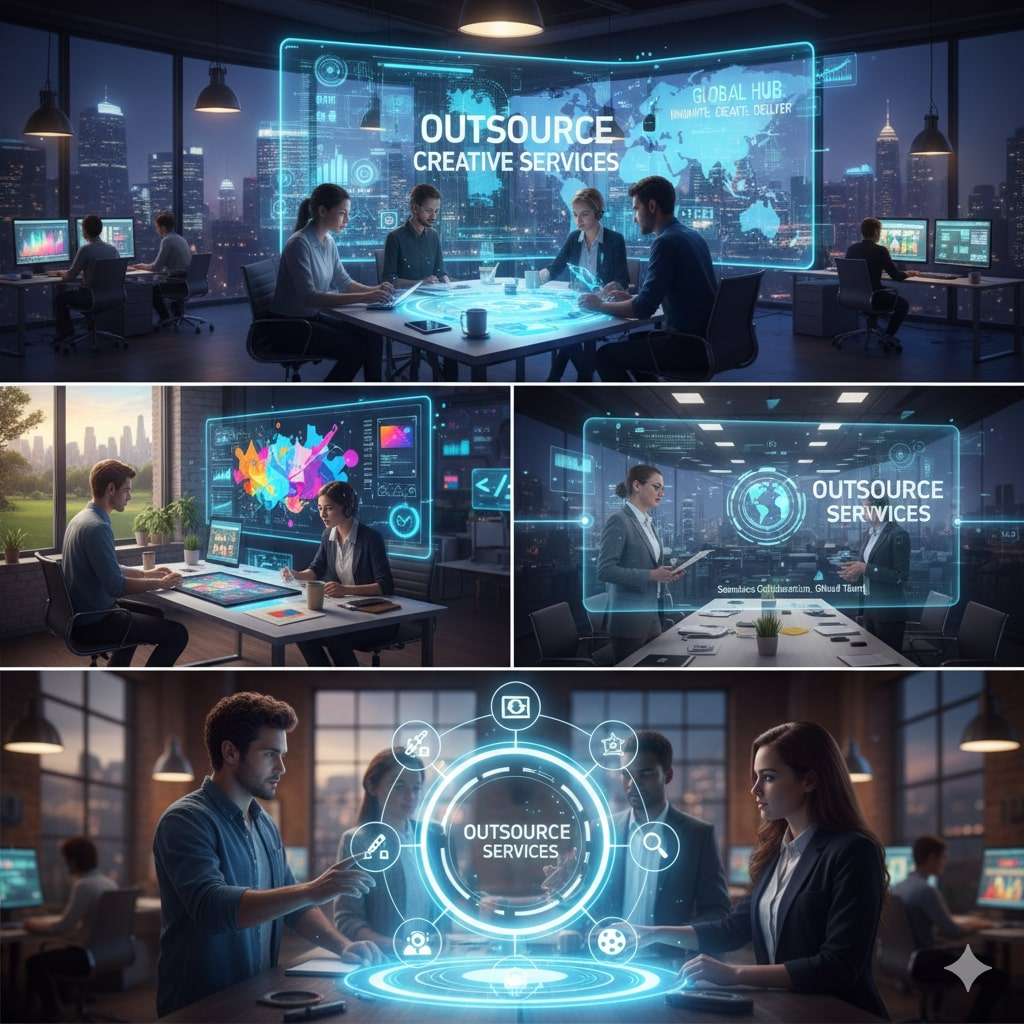
By leveraging specialized Creative Services, businesses are no longer limited by their local talent pool or internal bandwidth. From foundational 2D Services to high-end VFX and AR-VR workflows, outsourcing has become the engine of the modern digital enterprise.
To achieve this at scale, savvy businesses are moving away from traditional in-house models and choosing to Outsource creative works. This strategic move allows them to bypass the bottlenecks of recruitment and infrastructure, moving directly into high-impact content production. By leveraging professional Creative Services, companies can accelerate their digital journey through high-fidelity 2D Services, cinematic VFX, and immersive AR-VR experiences.
1. The Creative Bottleneck in Digital Transformation
Digital transformation requires an almost exponential increase in visual assets. Whether it’s a retail giant moving toward an “AR-Try-On” experience or a manufacturing firm digitizing its training manuals into interactive 3D modules, the demand for high-quality creative output often outstrips what an internal team can provide.
When a company attempts to handle all Creative Services in-house during a transformation phase, they often hit the “Specialization Wall.” A talented graphic designer might be excellent at branding but may lack the technical proficiency required for 2D Graphics & Illustration optimized for real-time game engines or the complex rigors of VFX production.
This is why businesses Outsource creative design services. It isn’t just about reducing costs; it’s about gaining immediate access to a “bench” of specialists who are already masters of the specific tools required for modern digital platforms.
2. The Foundational Role of 2D Services in DX
Every digital experience, no matter how advanced, starts with a 2D foundation. In the context of digital transformation, 2D Services are the blueprints and the “skin” of the digital world.
Branding and UI/UX Consistency
As businesses digitize their workflows, they often launch new web portals, mobile apps, and internal dashboards. Maintaining brand consistency across these hundreds of digital touchpoints is a massive undertaking. Professional 2D Graphics & Illustration teams ensure that every icon, button, and illustrative element is pixel-perfect and aligned with the brand’s digital identity.
From Static to Dynamic: 2D Graphics & Illustration
In the transition to a digital-first model, static PDF manuals and brochures are being replaced by dynamic, illustrated content. Businesses Outsource creative services to transform complex technical data into easy-to-digest infographics and instructional illustrations. These assets are critical for “Knowledge Transformation”—ensuring that both employees and customers can navigate new digital systems intuitively.
3. VFX: Adding Realism to the Digital Presence
As brands move their presence into the digital realm, the “wow factor” is a key differentiator. This is particularly true for industries like real estate, film, and e-commerce, where the digital representation must look as good as—if not better than—the real thing.
Professional Post-Production and VFX
When you Outsource creative works in the VFX space, you are hiring a team that can handle:
- Digital Matte Painting: Creating expansive digital environments.
- Compositing: Seamlessly blending real-world footage with digital elements.
- Particle Effects: Simulating natural phenomena like fire, water, or smoke for promotional videos or interactive simulations.
For a business, high-end VFX signals digital maturity. It transforms a standard corporate video into a cinematic experience that captures attention in an era of information overload.
4. The Pinnacle of Digital Transformation: AR and VR
The most significant frontier of digital transformation today is spatial computing. Augmented Reality (AR) and Virtual Reality (VR) are redefining how we interact with information.
Immersive Training and Simulation
Manufacturing and healthcare firms are leveraging AR-VR Outsourcing workflows to create risk-free training environments. Instead of training a surgeon on a live patient or a technician on a multi-million dollar machine, businesses use VR simulations. Creating these worlds requires a sophisticated integration of 3D modeling, 2D Services (for the UI/UX within the headset), and VFX (to simulate realistic lighting and physics).
Interactive Retail and Real Estate
Digital transformation in retail means letting a customer “place” a 3D sofa in their living room via their smartphone. In real estate, it means a “Virtual Walkthrough” of a building that hasn’t been built yet. By choosing to Outsource creative design services, firms can deliver these complex interactive 3D experiences without investing in expensive in-house render farms or specialized AR/VR developer talent.
5. Structuring the Workflow: How Outsourcing Accelerates DX
The true secret to faster transformation lies in the outsourcing workflow. Companies like Outsource Creative Works utilize a structured pipeline that mirrors the speed of the digital economy:
- Discovery & Asset Audit: Identifying existing assets (CAD files, photos, brand guides) that can be digitized.
- Conceptualization (2D Services): Rapid storyboarding and 2D Graphics & Illustration to define the visual direction.
- Production (3D/VFX/AR): High-volume asset creation by global specialized teams.
- Integration & Optimization: Ensuring the creative assets run smoothly on the target digital platform (Web, App, or VR Headset).
- 24/7 Iteration: Leveraging global time zones to ensure that updates are made while the core business team sleeps, effectively doubling the speed of production.
6. The 2025 Trend: The Human-AI Hybrid Creative Team
A major driver of faster digital transformation in 2025 is the integration of AI into the creative process. Smart businesses Outsource creative services to partners who use AI to handle the “grunt work”—such as background removal in 2D Services or initial mesh generation in 3D modeling—while human artists focus on the final 10% of creative polish and brand alignment. This hybrid approach ensures that digital assets are produced faster and more cost-effectively than ever before.
🚀 Digital Transformation: Powered by Creative Assets
Digital transformation is often discussed in terms of code and infrastructure, but the user experience is entirely visual. Every new digital touchpoint—whether a mobile app, a virtual storefront, or an internal data dashboard—requires professional design to be effective.
Smart firms utilize Creative Services to ensure that their technological upgrades are met with user-friendly and aesthetically compelling designs. Without this “visual layer,” digital transformation remains an abstract concept that fails to engage customers or employees.
1. Scaling at the Speed of Innovation
When a company launches a new digital platform, the demand for assets—icons, banners, promotional videos, and tutorials—peaks instantly. Maintaining a full-time staff large enough to handle these spikes is financially inefficient. By choosing to Outsource creative design services, businesses can scale their output overnight, ensuring that the visual rollout matches the technical speed of their transformation.
2. Accessing Niche Expertise for New Frontiers
2025 has seen the rise of “spatial computing” and hyper-realistic digital twins. Most traditional design teams are not equipped for the complexities of VFX or Augmented Reality – Virtual Reality modeling. Outsourcing allows firms to borrow this high-level expertise exactly when they need it, without the long-term overhead of training or specialized hardware.
🎨 The Foundation: 2D Services and Visual Clarity
While 3D and VR grab the headlines, the backbone of digital transformation remains rooted in 2D Services. For a digital shift to be successful, communication must be crystal clear.
The Role of 2D Graphics & Illustration
In a digital-first environment, businesses deal with massive amounts of data. Transforming this data into a usable format is a primary function of 2D Graphics & Illustration.
- Infographics & Dashboards: Complex reports are transformed into digestible, interactive visuals that allow stakeholders to make decisions faster.
- UI/UX Assets: Every button, menu, and layout in a new software system is a product of 2D Services.
- Brand Consistency: As companies move across more digital platforms (TikTok, LinkedIn, Meta, and proprietary apps), keeping a consistent visual identity is critical. Outsourcing these tasks ensures that no matter where the customer interacts with the brand, the quality remains top-tier.
🎥 The Immersive Edge: VFX and AR-VR Workflows
Digital transformation in 2025 extends beyond the screen. Retailers are building AR “try-on” experiences, and industrial firms are using VR for high-stakes safety training. These workflows are highly technical and depend heavily on specialized outsourcing.
Streamlining the AR-VR Pipeline
The creation of an Augmented Reality – Virtual Reality experience involves a multi-step workflow that is perfectly suited for outsourcing:
- Conceptualization: Using 2D Graphics & Illustration to storyboard the user journey.
- Asset Creation: Building high-fidelity 3D models and environments.
- VFX Integration: Adding realistic lighting, particles, and motion effects that make the virtual world feel “real.”
- Optimization: Ensuring the models are “light” enough to run smoothly on mobile devices or headsets like the Apple Vision Pro.
By delegating these technical phases to an expert partner, businesses can focus on the strategy of the transformation while the partner handles the execution of the immersive media.
Conclusion: Strategy Over Execution
Digital transformation is a massive undertaking. Businesses that try to do everything themselves often find their transformation stalled by “Creative Debt”—a backlog of assets that haven’t been created yet.
By choosing to Outsource creative works, you free your internal team to focus on high-level strategy and innovation. You shift the burden of technical execution to specialized partners who can provide world-class 2D Services, VFX, and AR-VR solutions. In the race to go digital, the winners aren’t those who work the hardest; they are those who build the smartest networks.
Leveraging Outsource creative design services is the ultimate shortcut to a polished, professional, and powerful digital future.
Frequently Asked Questions (FAQs)
1. How does outsourcing help in faster digital transformation?
Outsourcing provides immediate access to specialized talent and high-end technology that would take months to build in-house. This allows businesses to produce the massive volume of digital assets (2D, 3D, VFX) required for transformation projects without any delays in recruitment or training.
2. What are the most common Creative Services businesses outsource?
Businesses frequently outsource 2D Services (branding, UI design, illustration), 3D Modeling, VFX for marketing videos, and the development of interactive AR-VR content for training or retail applications.
3. Why are 2D Services important for 3D/AR/VR projects?
Every 3D environment requires 2D assets for textures, user interfaces (menus and buttons), and initial concept storyboards. High-quality 2D Graphics & Illustration are essential to make a 3D world look realistic and functional.
4. Is outsourcing VFX only for film companies?
No. Modern businesses use VFX for high-impact marketing, interactive product demonstrations, and creating realistic digital twins in the manufacturing and real estate sectors. It helps brands stand out with cinematic-quality digital content.
5. What industries benefit most from AR-VR Outsourcing workflows?
Healthcare (surgical training), Real Estate (virtual tours), Manufacturing (safety training), and Retail (virtual try-ons) are currently leading the way in leveraging outsourced AR-VR workflows to drive their digital transformation.
6. How do I ensure brand consistency when I Outsource creative works?
By providing a clear Digital Brand Guide and working with a professional partner that has a dedicated QA/QC (Quality Assurance) process. Most firms provide a dedicated project manager to ensure that all Outsource creative design services align perfectly with your brand’s vision.
Related Blogs
Art assets in different styles like 2D art for interactive applications, Games, and UI. We are having more than 15 years of experience