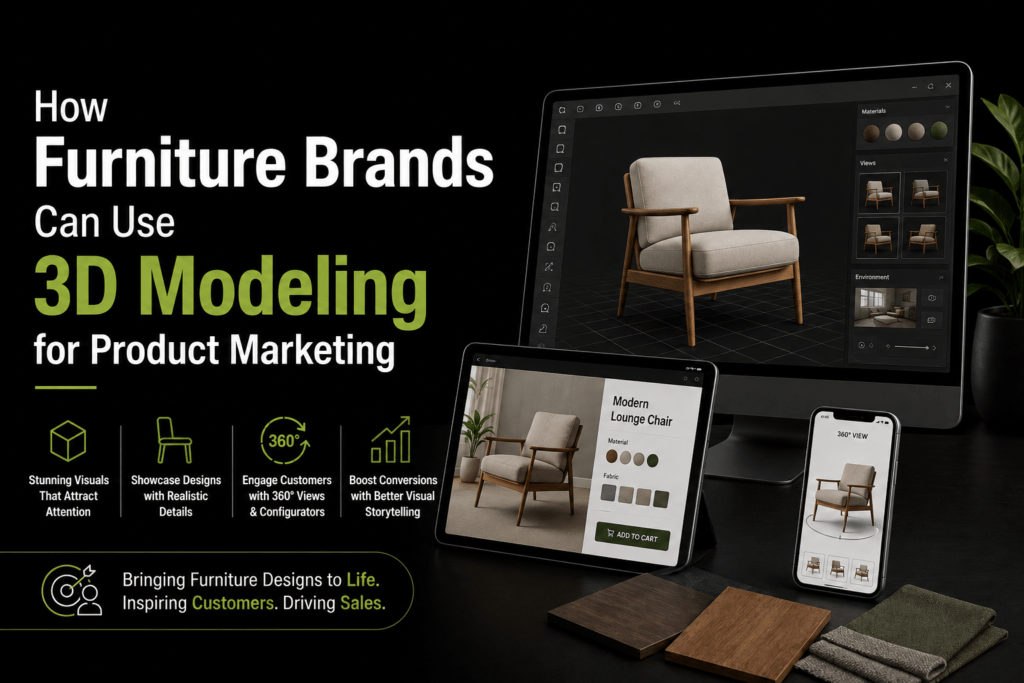
How Furniture Brands Can Use 3D Modeling for Product Marketing
Posted on : Sep 21, 2026
Furniture marketing has always depended on helping people imagine a product in their lives. A customer may like the look of a sofa, dining table, bed, cabinet, or office chair, but the purchase decision often comes down to practical questions: Will it fit? Will the fabric look right in my space? How will the finish appear in different lighting? What happens if I choose a different size, leg style, or colour?
Traditional product photography can answer some of these questions, but it is expensive and difficult to scale. Every new product, fabric, finish, room setting, and camera angle can require samples, logistics, styling, studio time, photography, retouching, and reshoots. For brands with large or highly configurable catalogs, the cost and delay can become a major marketing bottleneck.
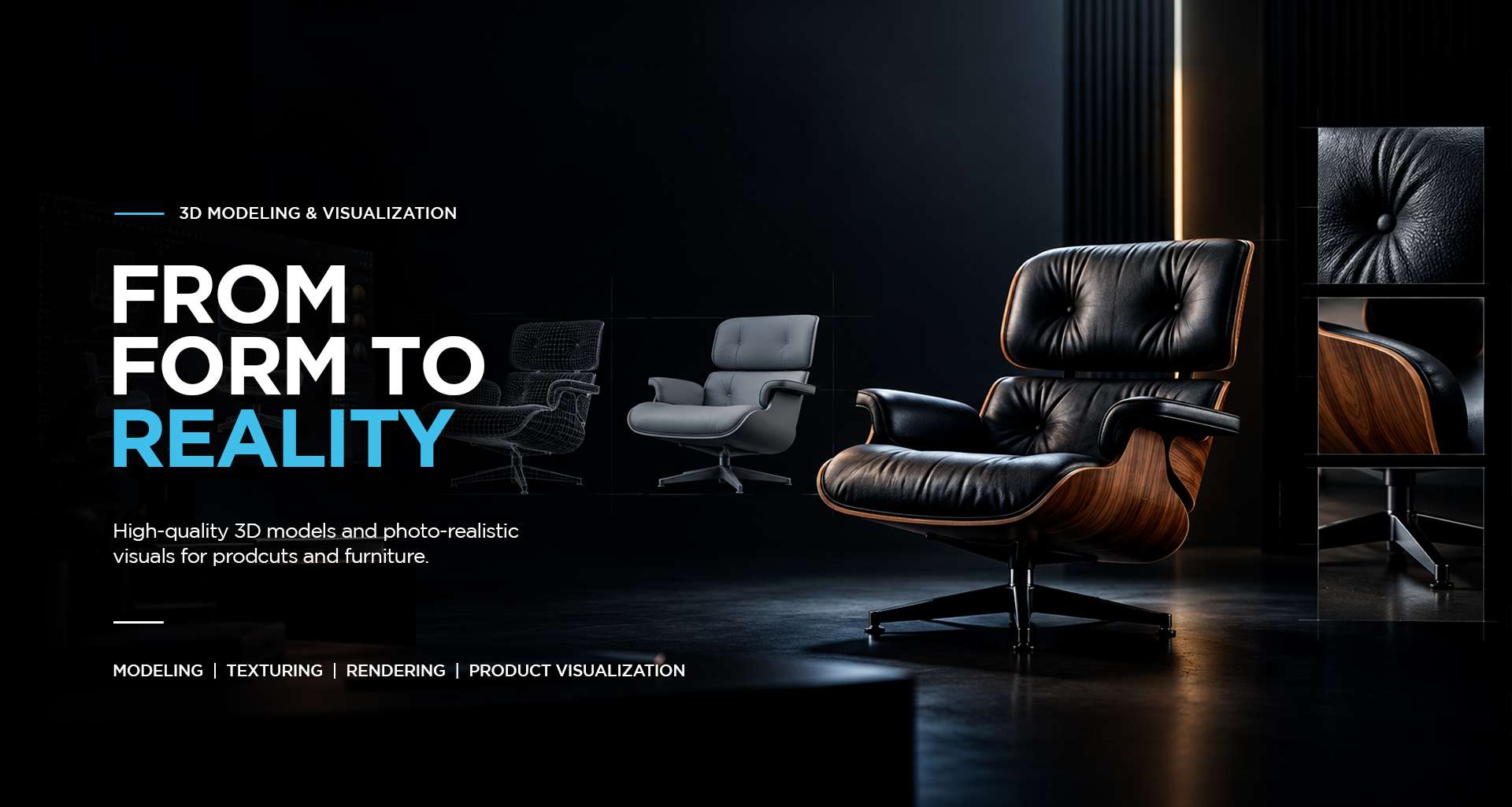
3D modeling changes that equation. A well-built 3D furniture model can become a reusable digital asset for product pages, photorealistic renders, lifestyle scenes, 360-degree viewers, configurators, augmented reality, product videos, social media, sales presentations, and trade-show content.
Outsource Creative Works helps furniture brands create these assets at scale. By combining 3D modeling, rendering, visualisation, animation, AR/VR support, and interactive content production, the company helps brands present products more clearly, reduce dependence on repeated photoshoots, and deliver richer content across digital channels.
Why Furniture Brands Need Better Digital Product Content
Furniture is a high-consideration purchase. Customers cannot always touch the upholstery, check the finish, sit in the chair, or see the item inside their own room when shopping online. This creates an imagination gap. Shoppers must judge scale, material, comfort, colour, and style from limited images.
Static photography remains useful, especially for brand campaigns and hero images. But it has limits. A standard product page may show only a few views of one configuration. It may not show every fabric, finish, size, module, or room setting. When customers cannot confidently picture a product in their space, they may delay buying, choose a competitor, or place an order that later results in a return.
Photorealistic 3D visualisation helps narrow this gap by giving customers clearer, more flexible product information. Accurate material mapping and lighting simulation can make digital visualisation a stronger basis for evaluating furniture finishes and configurations online.
What Is 3D Furniture Modeling?
3D furniture modeling is the creation of a digital three-dimensional version of a furniture product. The model is built using product dimensions, CAD data, technical drawings, photographs, material samples, or physical references.
A professional 3D model can include:
- Accurate product geometry and scale
- Upholstery forms, stitching, seams, cushions, and piping
- Wood grain, metal, glass, stone, leather, fabric, and plastic materials
- Different sizes, modules, and configuration options
- Colour and finish variations
- Hardware, handles, feet, and detail components
- Optimised versions for websites, AR, configurators, animation, and rendering
Once created, the model can be reused. This is the real value. Instead of creating a new visual from scratch for every campaign or product variation, the brand starts with a structured digital asset that can produce many forms of marketing content.
Create Photorealistic Visuals Without Repeated Photoshoots
One of the most immediate benefits of 3D modeling is virtual product photography. A furniture brand can create studio-style images, lifestyle scenes, close-up detail views, and seasonal campaign visuals without physically moving products into a photography studio each time.
For example, one 3D model of a dining chair can be rendered:
- On a clean white e-commerce background
- In a modern dining room
- In a Scandinavian-style interior
- In a luxury hospitality setting
- With different upholstery fabrics
- With different wood stains or metal finishes
- From multiple camera angles
- In seasonal or campaign-specific styling
Traditional photography may require a physical product sample, a studio, props, a photographer, lighting, a stylist, transport, and retouching. With a 3D asset, the brand can change the scene, camera, material, or lighting digitally.
Industry sources describe 3D product data as a way to replace or complement conventional photo and video shoots, enabling brands to render variants without repeated product shipping, studios, or full reshoots.myhfa+1
This does not mean brands must stop using photography. Instead, 3D gives them a scalable content engine that can support photography, fill content gaps, and produce assets that are difficult or costly to photograph.
Showcase Every Product Variation
Furniture brands often sell products with many options. A sofa may be available in several sizes, fabrics, leg finishes, arm styles, modular layouts, and cushion options. A dining table may have different lengths, top materials, bases, edge profiles, and colours. Photographing every combination is usually unrealistic.
3D modeling makes variation marketing manageable. Once the base model is built, teams can create controlled material and geometry variations. This gives customers a clearer view of what they can order and helps sales teams communicate options accurately.
3D variation content is particularly useful for:
- Upholstery fabric collections
- Leather grades and colours
- Wood stains and veneer patterns
- Metal finishes
- Different product sizes
- Modular sofa layouts
- Optional legs, handles, bases, or accessories
- Commercial furniture configurations
A digital asset pipeline makes it possible to show more of the catalog without manufacturing or photographing every variation. Furniture marketing guidance notes that a single 3D product asset can be used to render multiple versions with consistent visual quality, supporting faster launches and more flexible merchandising.
Improve E-Commerce Product Pages
E-commerce product pages need to do more than display a product. They need to answer questions that would normally be answered in a showroom. Customers want to inspect details, understand proportions, compare variations, and feel confident before committing to a purchase.
3D modeling supports stronger product pages through:
- 360-degree product spins
- Zoomable detail views
- Interactive material and colour selection
- Product configuration tools
- Exploded or feature-focused views
- Accurate scale references
- Short product animations
- AR-ready “view in room” experiences
Interactive 3D can reduce the distance between online browsing and physical product evaluation. A customer who can rotate a sofa, zoom into upholstery, change its fabric, and view a sectional layout is better informed than a customer who sees only two static images.
3D configurators are especially valuable for products with complex options. They let customers make selections and see changes in real time. Recent furniture-commerce analysis links visual configuration with greater buyer confidence, lower option-related errors, and improved sales processes.londondynamics+2
Use 3D Models for AR Experiences
Furniture is one of the strongest use cases for augmented reality because placement and scale matter so much. Customers often hesitate because they do not know whether a piece will fit, match the room, or work with existing furnishings.
AR gives customers the ability to place a digital version of the product in their own environment using a smartphone or tablet. They can view the sofa against their wall, check whether a table fits the dining area, or compare a lamp with other room elements.
A 3D model prepared for AR must be accurate, lightweight, and optimised for mobile performance. It should use efficient geometry, suitable textures, correct scale, and compatible file formats.
AR can help furniture brands:
- Improve shopper confidence
- Make product scale easier to understand
- Show how products work in real rooms
- Encourage engagement on product pages
- Support retailers and sales teams
- Reduce uncertainty before purchase
Industry estimates vary by platform and product category, but recent furniture AR coverage consistently links realistic placement and interactive visualisation with improved confidence, longer engagement, higher conversion potential, and lower return risk.cylindo+2
Build Consistent Content Across Channels
One of the strongest advantages of 3D modeling is consistency. When a furniture brand uses approved 3D assets, it can generate visuals that use the same proportions, materials, colours, and product details across every channel.
The same model can support:
- E-commerce product pages
- Website banners and landing pages
- Social media graphics
- Email marketing campaigns
- Printed catalogs
- Digital brochures
- Retail displays
- Sales presentations
- Product launch videos
- Trade-show screens
- Marketplace listings
- AR and interactive 3D experiences
This reduces the risk of product inconsistency. For example, a sofa’s fabric colour should not look significantly different between a website image, a brochure render, a sales presentation, and an AR viewer. A central 3D asset library helps control those details.
It also speeds up campaign production. Once the base asset is complete, a marketing team can request new visuals without repeating the full modeling process.
Speed Up Product Launches
Furniture brands often need marketing material before full physical inventory is available. Traditional photography may require final samples to be manufactured, shipped, and styled before a campaign can begin. This can delay e-commerce listings, buyer presentations, catalog preparation, and launch planning.
3D models can be created from CAD files, design drawings, specifications, and material references before full product availability. This allows brands to prepare product visuals earlier in the development cycle.
For a new collection, 3D can support:
- Pre-launch presentations for buyers and distributors
- Early e-commerce listing preparation
- Catalog layouts before sample photography is scheduled
- Launch campaigns using multiple room settings
- Product configuration planning
- Sales training materials
- Virtual showroom content
The ability to create marketing-ready visuals before products are physically available can improve speed to market and help brands coordinate product development with sales and marketing schedules.myhfa
Reduce Photography and Logistics Costs
Furniture photography can be expensive because products are large, heavy, and difficult to move. A studio shoot may involve shipping, warehousing, unpacking, assembly, styling, photography, retouching, and return logistics. For large collections, these expenses multiply quickly.
3D visualization does not eliminate all photography needs, but it can reduce the number of physical shoots required. A brand may use 3D for catalog-scale content, variation images, digital room scenes, and product configuration, while reserving traditional photography for selected hero shots, lifestyle campaigns, or editorial storytelling.
The financial value comes from reuse. A 3D model is an upfront investment that can generate many images, scenes, animations, and variants over time. Some industry analyses report that virtual photography can reduce reliance on physical prototypes, studio logistics, and repeated shooting for every variation, though actual savings depend on catalog size, content requirements, and the quality level required.myhfa+2
Support Retailers, Dealers, and Sales Teams
3D modeling is not only for direct-to-consumer e-commerce. It can also make life easier for retailers, dealers, interior designers, architects, and sales representatives.
A sales team can use 3D visuals to show a customer how a product looks in different fabrics, finishes, and layouts. A dealer can use a configurator to help a buyer choose between options. An interior designer can include accurate product visuals in a client presentation. A retailer can display a larger catalog without needing every variation on the showroom floor.
For commercial furniture brands, 3D can support:
- Workspace planning
- Hospitality presentations
- Healthcare and education furniture specifications
- Modular system configurations
- Dealer sales tools
- Product training
- Installation and assembly animations
This makes 3D a sales-enablement tool as well as a marketing tool.
Why Accuracy Matters
Furniture visuals need to be attractive, but they also need to be trustworthy. If a 3D model has incorrect proportions, unrealistic fabric, wrong wood grain, inaccurate seams, or misleading colours, customers may lose confidence or receive a product that does not meet expectations.
High-quality furniture modeling requires attention to:
- Dimensions and overall scale
- Cushion softness and upholstery shape
- Stitching, piping, tufting, and seam placement
- Material texture and reflectivity
- Fabric direction and pattern scale
- Wood grain direction and finish
- Hardware, legs, handles, and construction details
- Consistency across variants
- Platform-specific optimisation for web, AR, and real-time use
This is why professional modeling and rendering remain important. A quick generic model may be sufficient for an internal concept, but customer-facing marketing requires assets that represent the actual product accurately.
How Outsource Creative Works Helps
Outsource Creative Works provides flexible creative production support for furniture brands that need scalable 3D content. The company can help transform product information into professional visual assets for marketing, e-commerce, sales, and interactive experiences.
Services can include:
- 3D furniture modeling from drawings, CAD data, photographs, or samples
- Product rendering and studio-style visuals
- Lifestyle and room-scene visualisation
- Material, fabric, wood, and finish development
- Product variation and configuration support
- 360-degree product views
- AR/VR-ready asset preparation
- Interactive 3D and configurator content
- 3D animation and product demonstrations
- Catalog-scale production support
- Content adaptation for websites, marketplaces, social media, and presentations
The advantages of outsourcing include:
- Scalable capacity: Add creative production resources during catalog launches, seasonal campaigns, or high-volume product updates
- Specialist expertise: Access 3D modelers, texture artists, visualisers, animators, and interactive-content specialists
- Cost flexibility: Use professional resources without maintaining a large full-time 3D department
- Faster output: Produce multiple product variations and campaign visuals from reusable digital assets
- Channel readiness: Prepare content for e-commerce, AR, social media, catalogs, video, and sales presentations
- Quality consistency: Work from approved product data, material references, brand guidelines, and review checkpoints
For furniture businesses, this means more than attractive renders. It means a stronger digital product foundation that can support marketing, sales, customer experience, and future commerce technology.
A Practical Workflow
- Define the asset purpose. Decide whether the model is needed for product pages, renders, AR, a configurator, animation, catalogs, or several channels.
- Gather product references. Provide drawings, CAD files, dimensions, product photographs, material samples, finish references, and brand guidance.
- Set the accuracy standard. Confirm what details must be modeled, which variants are required, and what scale or measurement rules apply.
- Create a pilot model. Start with one product or a small product family to approve modeling, materials, lighting, and output quality.
- Build reusable variation rules. Define fabrics, colours, sizes, bases, modules, and accessories so new variants can be produced consistently.
- Produce channel-specific outputs. Create web-ready models, high-resolution renders, AR files, animations, and print assets as needed.
- Maintain the asset library. Keep version-controlled models, material libraries, naming conventions, and product metadata for future campaigns.
This approach turns 3D production from a one-off creative expense into a repeatable marketing system.
The Future of Furniture Marketing
Furniture marketing is moving toward richer, more interactive product experiences. Customers increasingly expect to inspect products closely, compare materials, view configurations, and understand how furniture will look in a real space before they buy.
The brands that prepare reusable 3D product libraries now will be better positioned to use interactive commerce, AR, real-time configuration, virtual showrooms, AI-assisted content production, and digital retail tools in the future.
The goal is not to replace every photograph with a render. It is to give the brand more options. 3D provides the flexibility to create the right visual, in the right setting, for the right audience, without restarting the production process every time a new variation or channel appears.
SEO Keywords
3D furniture modeling, furniture product marketing, 3D furniture rendering, furniture e-commerce visualization, furniture product configurator, AR furniture visualization, photorealistic furniture renders, furniture marketing services, 3D product visualization, virtual furniture photography, interactive 3D furniture, Outsource Creative Works.
FAQs
1. How can furniture brands use 3D modeling for marketing?
Furniture brands can use 3D models to create product renders, lifestyle scenes, 360-degree viewers, product configurators, AR experiences, animations, catalogs, social media content, and sales presentations.
2. Can 3D furniture rendering replace product photography?
3D rendering can replace or complement traditional photography for many uses, especially product variations, catalog images, digital room scenes, and online content. Many brands still use photography for selected hero campaigns and editorial storytelling.
3. How does 3D modeling reduce furniture photography costs?
A reusable 3D model can generate multiple angles, materials, sizes, room scenes, and campaign visuals without repeatedly shipping, styling, and photographing physical products.
4. What is a furniture product configurator?
A furniture product configurator is an interactive tool that lets customers change options such as fabric, colour, size, legs, modules, or finishes and view the selected product in real time.
5. Can 3D furniture models be used for AR?
Yes. Optimised 3D furniture models can be prepared for augmented reality so customers can place products in their homes or offices using compatible mobile devices.
6. What information is needed to create a 3D furniture model?
Useful inputs include CAD files, technical drawings, product dimensions, photographs, material samples, colour and finish references, hardware details, and brand guidelines.
7. How does Outsource Creative Works help furniture brands?
Outsource Creative Works provides 3D furniture modeling, rendering, visualisation, variation support, AR/VR assets, interactive 3D content, animation, and scalable production services for furniture marketing and e-commerce.
Call to Action
Turn Every Furniture Product Into a Scalable Digital Marketing Asset
Your customers want to see more than a single product photo. They want to explore fabrics, finishes, dimensions, room settings, and real-world possibilities before they buy.
Outsource Creative Works helps furniture brands create photorealistic 3D models, high-impact renders, lifestyle visuals, interactive product content, AR-ready assets, and digital catalogs that make products easier to understand and easier to sell.
Ready to reduce photography bottlenecks and make your furniture catalog work harder across every digital channel? Visit www.outsourcecreativeworks.com to discuss your product visualization requirements and request a free consultation.