The Future of AI-Assisted 2D, 3D, Animation,VFX Production & Architectural Visualization
Posted on : Aug 21, 2026
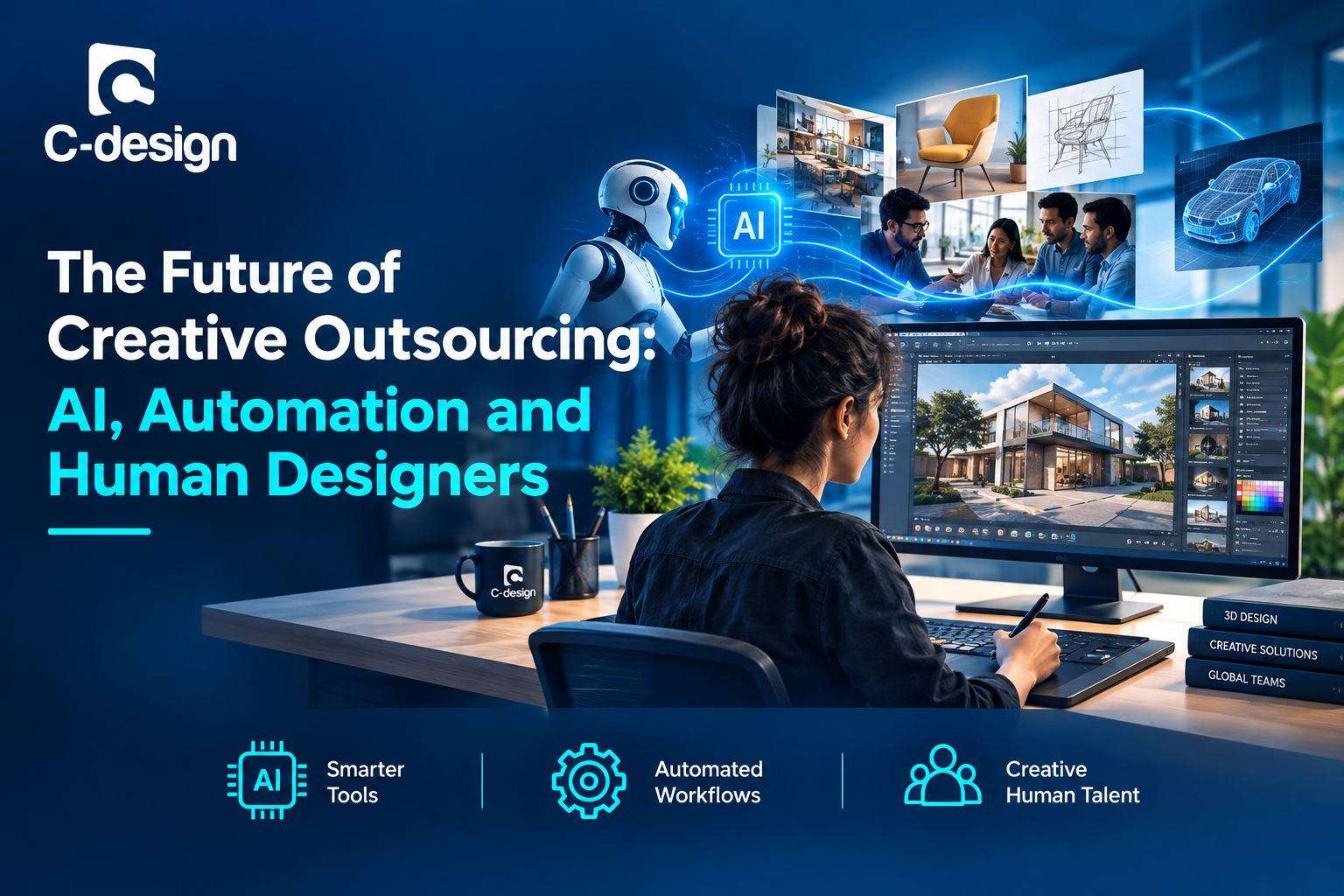
Artificial intelligence is no longer a distant idea for creative studios. In 2026, it is becoming part of day-to-day production across 2D art, 3D modeling, animation, VFX, architectural visualization, and interactive experiences. The change is not about replacing artists. It is about helping creative teams work faster, explore more options, and spend more time on the parts of a project where human judgment matters most.
For businesses, the opportunity is clear. AI can accelerate concept development, automate repetitive production tasks, improve real-time previews, and support the creation of larger volumes of visual content. At the same time, professional artists, designers, and technical specialists remain essential for quality, brand consistency, technical accuracy, and final approvals.
That is why the future belongs to human-in-the-loop production. This approach combines the speed of AI with the creative judgment and technical expertise of people. Outsource Creative Works helps businesses use this model effectively by providing flexible creative production support across 2D, 3D, animation, VFX, visualization, AR/VR, and interactive content.
What AI-Assisted Creative Production Means
AI-assisted creative production uses artificial intelligence to support—not replace—the work of artists, designers, animators, and visualizers. AI can generate concepts, automate routine tasks, create initial assets, enhance renders, and speed up iterations. Human professionals then review, refine, correct, and approve the final output.
In practice, this may include:
- Generative AI for concept art and early visual exploration.
- Image-to-3D and text-to-3D tools for rough asset creation.
- AI-assisted rigging, motion cleanup, and lip-sync in animation.
- AI-powered rotoscoping, compositing, and background generation in VFX.
- Real-time rendering and AI scene optimization in architectural visualization.
- Automated asset tagging, versioning, and content variations.
The result is a faster and more flexible workflow that still keeps people in control.
The Future of AI-Assisted 2D Art
2D art is one of the first creative fields to feel the impact of generative AI. Artists can use AI to quickly explore color palettes, compositions, character directions, environments, and style variations. Instead of starting with a blank canvas, they can begin with multiple ideas and develop the strongest one.
This does not make the artist less important. It makes the artist more strategic. A professional illustrator still decides which concept fits the brief, what emotions the work should communicate, and how the final artwork should represent the brand.
For businesses, AI-assisted 2D production can support faster marketing campaigns, storyboards, social media content, game concepts, product illustrations, and presentation materials. Human artists make sure the final work remains original, on-brand, and usable across channels.
AI-Assisted 3D Modeling and Asset Creation
Automated asset creation is one of the most exciting areas in 3D production. AI tools can now generate initial 3D forms from prompts, sketches, or reference images. This is useful for early concepting, rough product models, environment blockouts, and asset libraries.
However, AI-generated 3D models often need professional cleanup. Geometry may be uneven, topology may not be optimized, and materials may not match real products. For game engines, AR/VR applications, animation, or visualization, these details matter.
A strong AI-assisted 3D workflow looks like this:
- AI creates a fast starting point.
- A 3D artist corrects proportions and topology.
- Materials and UVs are refined.
- The asset is optimized for the target platform.
- A quality review confirms that it meets project standards.
This process gives businesses the speed of AI without sacrificing the quality needed for real production.
AI-Assisted Animation: Faster Motion, Better Control
Animation has traditionally required significant time for keyframing, cleanup, rigging, motion-capture processing, and lip-sync. AI is helping reduce this workload by automating many repetitive steps.
AI-assisted animation can support:
- Motion cleanup and interpolation.
- Automatic lip-sync from dialogue.
- Pose generation and motion suggestions.
- Retargeting animation between characters.
- Basic crowd and background motion.
- Faster storyboard and previs development.
The value is not that AI creates a finished performance on its own. Great animation depends on timing, character, emotion, storytelling, and directorial choices. Human animators still make those decisions. AI simply helps them reach the creative part of the work faster.
For brands, this means animated explainers, social content, product demos, training videos, and character content can be produced with greater speed and flexibility.
VFX Production: AI as a Production Accelerator
Visual effects production involves many labor-intensive tasks, including rotoscoping, tracking, compositing, object removal, clean plates, background extensions, and simulation setup. AI is increasingly helping teams automate or accelerate these stages.
In VFX, AI can help with:
- Rotoscoping and matte generation.
- Object tracking and masking.
- Background removal and replacement.
- Upscaling and denoising footage.
- Generating early concept plates and environment ideas.
- Supporting compositing and color workflows.
But VFX has very high quality expectations. A small visual inconsistency can break the illusion. This is why human compositors and VFX supervisors remain essential. They validate continuity, lighting, perspective, physics, and visual storytelling.
For businesses, the benefit is clear: AI-assisted VFX can reduce production time while experienced artists protect the quality of the final shot.
Real-Time Rendering Changes Architectural Visualization
Architectural visualization is moving rapidly toward real-time workflows. In the past, designers often waited hours for high-quality renders. Today, real-time rendering engines and AI-assisted tools make it possible to preview materials, lighting, camera angles, and scene changes much faster.
AI-assisted architectural visualization can support:
- Fast concept render generation.
- AI material and asset recommendations.
- Image-to-3D creation for furniture and décor.
- Lighting and scene enhancement.
- Faster real-time walkthroughs.
- Automated variations for interiors and exteriors.
This changes client communication. Architects, interior designers, developers, and real estate teams can show options earlier and make decisions faster. Instead of presenting only one final render, they can explore multiple scenarios with clients in real time.
Why Human-in-the-Loop Production Matters
The phrase human-in-the-loop means that people remain responsible for important creative and technical decisions. AI provides suggestions and acceleration, but a human reviews each stage and approves the final output.
This model is essential because AI can make errors. It may produce inconsistent objects, distorted geometry, incorrect anatomy, unrealistic materials, or visuals that do not match a client’s brand. Human oversight catches these problems.
Human-in-the-loop production protects:
- Brand consistency.
- Technical accuracy.
- Originality and creative direction.
- Copyright and ethical standards.
- Quality control and client trust.
The best future workflow is not AI-only. It is AI-enhanced, human-led production.
How Outsource Creative Works Helps Businesses
Outsource Creative Works helps businesses adopt AI-assisted production without losing creative control. The company provides flexible access to skilled artists, 3D modelers, animators, VFX specialists, and visualization teams who can work alongside AI tools.
This support helps businesses:
- Scale creative production without building a large in-house team.
- Use AI for speed while relying on professionals for quality.
- Produce 2D, 3D, animation, VFX, and visualization assets in one workflow.
- Handle high-volume work during campaigns, launches, or seasonal peaks.
- Maintain consistent brand standards across multiple formats.
- Turn AI-generated drafts into polished, production-ready content.
For companies that want innovation without unnecessary risk, this hybrid approach offers a practical advantage.
Benefits of AI-Assisted Outsourcing
Combining AI tools with outsourced creative services creates several benefits.
- Faster turnaround: AI handles repetitive early-stage work while artists focus on refinement.
- Better scalability: Teams can manage more assets, scenes, and variations.
- Cost efficiency: Businesses pay for the capacity they need without expanding permanent headcount.
- Creative flexibility: Multiple concepts and styles can be explored quickly.
- Technical quality: Professionals optimize assets for the right platform and format.
- Human accountability: Experts review outputs before delivery.
This makes AI-assisted outsourcing a strong option for brands, agencies, developers, and product companies.
Common Business Use Cases
AI-assisted creative workflows are useful across many industries and projects.
- E-commerce: Product models, renders, animations, and AR-ready assets.
- Architecture and real estate: Real-time visualization, virtual tours, and design options.
- Marketing: Campaign graphics, motion content, VFX ads, and social media assets.
- Entertainment and gaming: Environment concepts, background assets, animation cleanup, and promotional visuals.
- Training: Interactive simulations, animated explainers, and immersive learning content.
- Manufacturing: Product visualization, assembly animation, and digital presentations.
In every case, AI speeds up the process while human experts make sure the work is accurate and engaging.
Responsible Use of Generative AI
Businesses should also think carefully about how they use generative AI. Fast content creation is valuable, but it should not come at the cost of originality, confidentiality, or quality.
A responsible workflow includes:
- Using approved references and licensed assets.
- Protecting client files and product information.
- Reviewing AI output for errors or unintended similarities.
- Maintaining clear ownership and approval processes.
- Keeping human creative direction at the center.
Outsourcing to a professional creative partner helps establish these controls and prevents AI from becoming an unmanaged risk.
How Outsource Creative Works Helps You Stay Ahead
Outsource Creative Works was built to help studios, agencies, architects, and game developers take advantage of these shifts without the risk of building an entirely new pipeline in-house. Here’s what sets our approach apart:
- AI-assisted, human-refined production: we use generative AI and real-time rendering tools to accelerate early-stage work, then apply experienced 2D, 3D, and VFX artists to polish every deliverable to professional standard.
- End-to-end service coverage: from 2D animation and 3D character work to VFX compositing and full architectural visualization packages — stills, walkthroughs, and interactive renders.
- Faster turnaround, lower cost: AI-assisted concepting, asset creation, and rendering let us deliver production-ready work faster than traditional pipelines, without inflating your budget.
- Dedicated quality control: every AI-assisted output goes through human review for brand consistency, technical accuracy, and creative intent before it reaches you.
- Scalable teams: whether you need a single architectural walkthrough or an entire animated series’ worth of assets, our outsourcing model scales up or down with your project needs.
- Transparent collaboration: real-time rendering previews and structured review cycles keep you involved at every stage, so there are no surprises at final delivery.
Whether you’re a studio exploring AI-assisted animation for the first time, an architecture firm looking to speed up client presentations, or a VFX house scaling up for a big project, Outsource Creative Works acts as an extension of your team — bringing the latest AI-assisted tools together with experienced creative talent.
Conclusion:
The future of 2D, 3D, animation, VFX, and architectural visualization isn’t about AI replacing artists — it’s about AI removing the repetitive, time-consuming parts of production so human creativity can move faster and go further. Generative AI, AI-assisted animation, real-time rendering, and automated asset creation are already reshaping timelines and budgets across the industry, and 2026’s AI-native professional software tools are only accelerating that shift.
Studios and businesses that adopt human-in-the-loop, AI-assisted workflows now will be positioned to deliver higher-quality work, faster, and at lower cost — while those that wait risk falling behind on both fronts. Outsource Creative Works is built to help you make that shift confidently, combining cutting-edge AI-assisted tools with experienced creative oversight on every project.
SEO Keywords
AI-assisted creative production, generative AI for 3D, AI animation services, AI VFX production, real-time architectural visualization, automated 3D asset creation, human-in-the-loop production, 3D rendering services, animation outsourcing, VFX outsourcing, architectural visualization services, Outsource Creative Works.
Ready to Future-Proof Your Production Pipeline?
Whether you need AI-assisted 2D or 3D animation, VFX support, or photorealistic architectural visualization, Outsource Creative Works can help you move faster without compromising quality. Let’s talk about your next project.
Visit www.outsourcecreativeworks.com to explore our services and request a free quote today.
FAQs
1. What is AI-assisted animation, and how is it different from fully AI-generated animation?
AI-assisted animation uses artificial intelligence to speed up specific tasks — like in-betweening, lip-sync, or motion clean-up — while human animators still direct performance and finalize quality. Fully AI-generated animation, by contrast, relies on AI to produce most of the output with minimal human refinement, which often results in lower consistency for professional projects.
2. Will generative AI replace 3D artists and animators?
Not in professional production. Generative AI is excellent at rapid concepting and repetitive tasks, but it still requires skilled artists to direct, refine, and finish work to a client-ready standard. Most studios, including Outsource Creative Works, use a human-in-the-loop model where AI accelerates the process and artists control final quality.
3. How is AI changing architectural visualization specifically?
AI is speeding up nearly every stage of architectural visualization — from generating early concept massing studies to producing photorealistic materials, lighting, and even real-time interactive walkthroughs. This allows architecture and real estate firms to get client approvals faster and iterate on designs more freely.
4. What is real-time rendering, and why does it matter for VFX and animation?
Real-time rendering displays near-final quality visuals instantly, instead of requiring long render times per frame. It’s used in virtual production, interactive architectural walkthroughs, and faster client review cycles, significantly reducing overall production timelines for animation and VFX projects.
5. Is outsourcing AI-assisted animation and VFX production cost-effective?
Yes. Outsourcing to a studio that already has AI-assisted workflows in place removes the cost and time of building that infrastructure yourself. It also gives you access to experienced artists and quality control processes, so you get faster turnaround at a lower overall cost than scaling an in-house team from scratch.
6. What professional 3D software trends should studios watch in 2026?
Major 3D and animation tools are integrating AI-assisted rigging, procedural environment generation, smarter asset management, and tighter real-time engine integration directly into their core software. Studios that adapt their pipelines to these AI-native features will see faster production and lower costs compared to those relying purely on traditional workflows.
7. How do I get started with Outsource Creative Works for my next project?
Simply reach out through our website with details about your project — whether it’s 2D/3D animation, VFX, or architectural visualization. Our team will review your requirements and put together a tailored, AI-assisted production plan with a clear timeline and quote.
Call to Action
The future of creative production is AI-assisted, real-time, and human-led. If your business wants to create more 2D art, 3D models, animations, VFX, visualizations, and immersive content without overloading its internal team, Outsource Creative Works is ready to help.
Our creative professionals combine modern AI-enabled workflows with expert artistic and technical oversight to deliver high-quality, production-ready results. Visit www.outsourcecreativeworks.com to discuss your next project and scale your creative output with confidence.
Tags
AI-assisted creative production, Generative AI, AI animation, AI VFX, real-time rendering, architectural visualization, 3D asset creation, human-in-the-loop production, 2D art outsourcing, 3D modeling outsourcing, animation outsourcing, VFX outsourcing, Outsource Creative Works.
Related Blogs
Art assets in different styles like 2D art for interactive applications, Games, and UI. We are having more than 15 years of experience