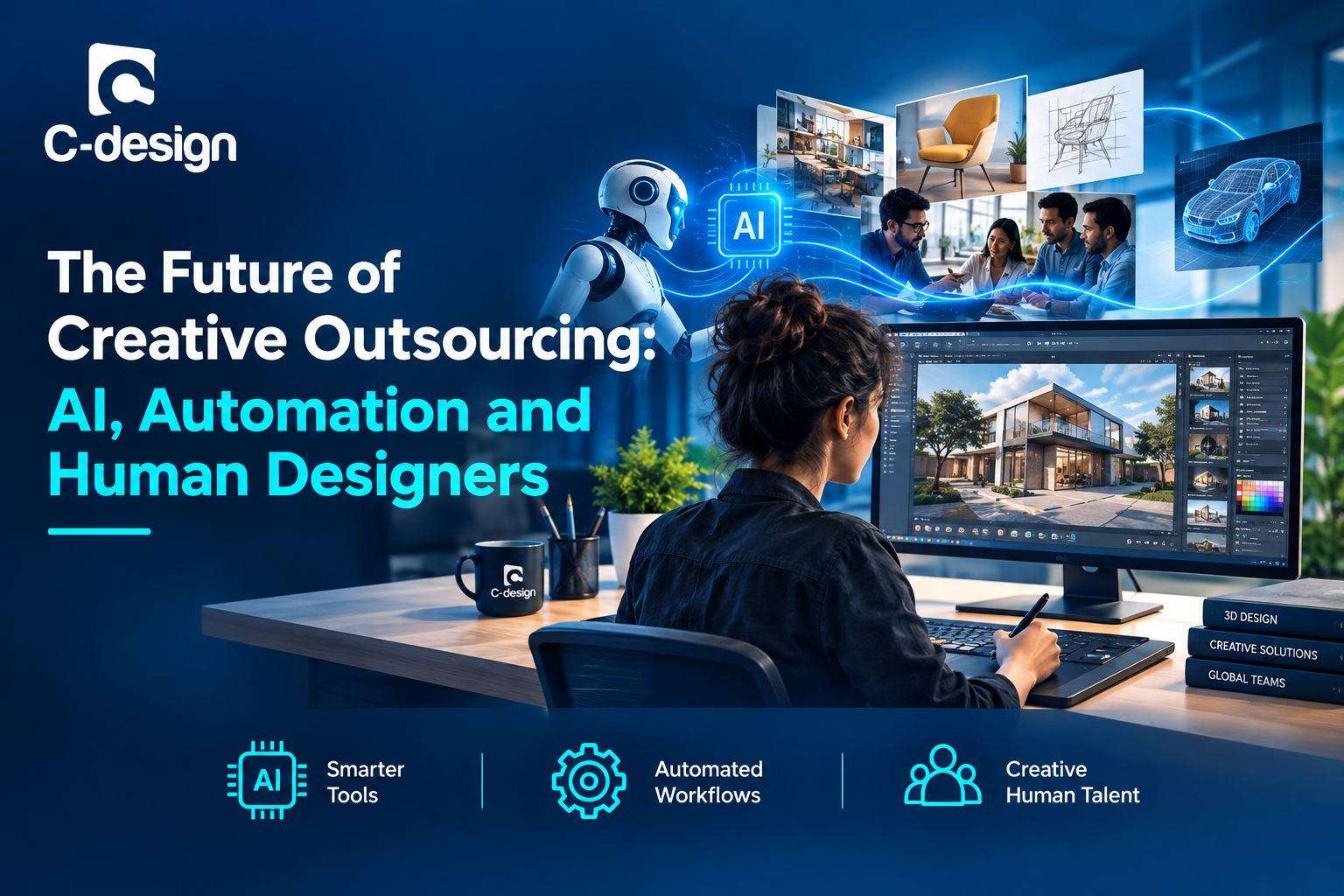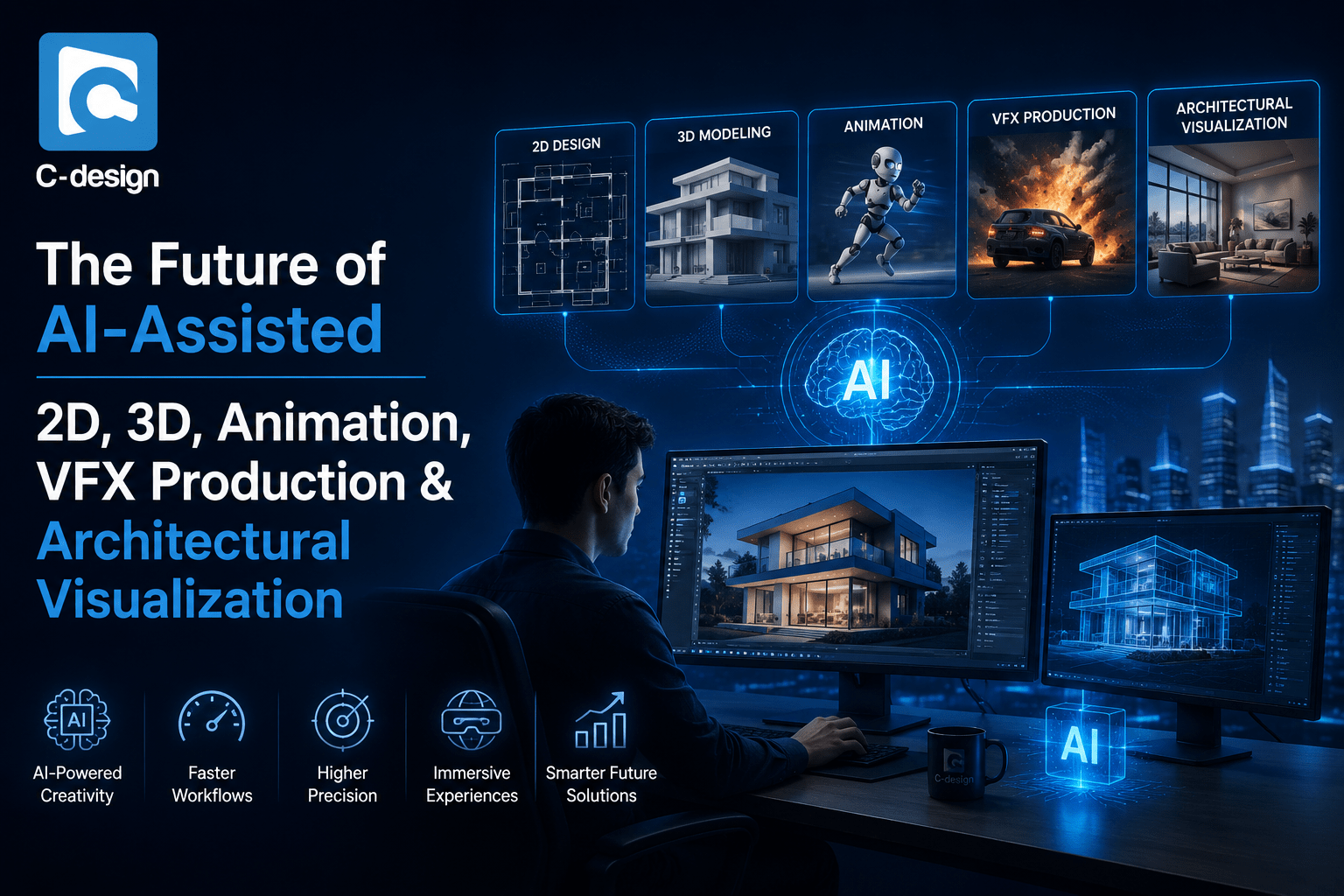
The Future of Creative Outsourcing: AI – Augmented workflows & Human Touch
Posted on : Nov 18, 2025
The landscape of Creative Services is undergoing its most profound transformation since the advent of digital tools. The proliferation of Generative AI (GenAI) has irrevocably altered how content is conceived, produced, and consumed. For growing brands and design agencies, this technology presents a unique choice: see AI as a threat to creativity, or embrace it as the ultimate accelerator.
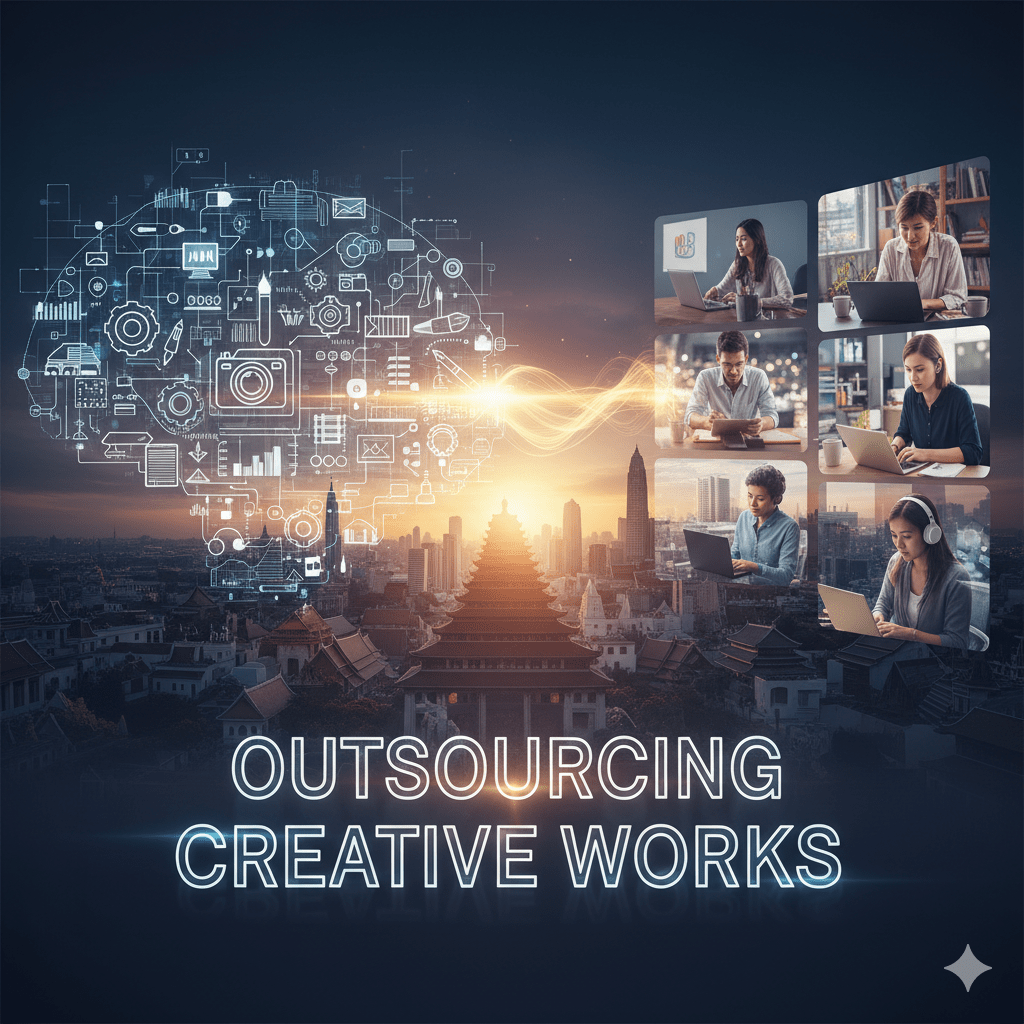
The new model for Outsource creative services in 2025 is defined by AI-Augmented Workflows. This strategic shift allows partners to handle staggering volumes of high-demand content—from rapid 2D Graphics & Illustration to complex Augmented Reality – Virtual Reality (AR/VR) assets—while freeing human experts to focus on the high-value tasks only they can perform: strategic vision, emotional resonance, and brand guardianship.
The creative industry is on the cusp of its most profound transformation since the desktop publishing revolution. Artificial Intelligence, particularly Generative AI, has irrevocably altered the production landscape, raising existential questions about the future of Creative Services. Far from making human expertise obsolete, however, AI is forging a new, powerful alliance: the AI-Augmented Workflow where the speed of the machine meets the indispensable empathy and judgment of the human touch.
For businesses relying on Outsource creative services, the future is not about replacing human talent with AI; it’s about strategically partnering with providers who have mastered this delicate synthesis. The next era of successful Outsource creative works will be defined by vendors who operate not as labor pools, but as AI Orchestrators—using intelligent tools to supercharge output while preserving brand integrity and creative narrative across all channels, from high-volume 2D Services to complex VFX and AR-VR Outsourcing.
Part I: The Operational Transformation: AI as the Scalability Engine
The most immediate and profound impact of AI on Outsource creative services is the mastery of scale and speed, solving the persistent problem of workload bottlenecks.
1. Automation of High-Volume, Repetitive 2D Services
AI excels at automation, handling the labor-intensive production tasks that previously consumed hours of human designer time.
- Variant Generation at Scale: Growing brands often require hundreds of variations of a single campaign asset (different sizes, languages, calls-to-action). AI tools can now generate these 2D Graphics & Illustration variants automatically from a master template, dramatically reducing the turnaround time for bulk 2D Services without sacrificing quality.
- Intelligent Asset Tagging and Organization: AI algorithms automate the tagging, categorization, and optimization of assets, ensuring the outsourced deliverables are immediately searchable and organized within the client’s Digital Asset Management (DAM) system. This eliminates hours of manual post-production setup.
- Rapid Image Manipulation: Tasks like background removal, image masking, and basic color correction—essential steps in any photography or visualization project—are now executed instantly by AI tools, allowing human artists to focus solely on high-level artistic refinement.
2. Outsource Creative Services for Hyper-Personalization
The next frontier of marketing demands personalization at scale, which is only achievable through AI-augmented workflows.
- Contextual 3D Rendering and Visualization: For e-commerce, AI can analyze customer data (location, weather, local trends) and automatically generate 3D Rendering of products (like furniture or apparel) shown in contextually relevant environments, increasing engagement. The outsourced team’s role shifts from creating one static scene to managing the intelligent engine that generates thousands.
- Dynamic Content Creation: AI assists in rapidly creating dynamic content that changes based on user behavior. The Outsource creative works partner integrates this AI framework into the design process, ensuring the automated content remains flawlessly on-brand.
Part II: The Human Imperative: Where AI Stops and Art Begins
While AI can automate production, it cannot replace the human elements of strategy, emotional intelligence, and brand stewardship. This is the core value proposition of future Creative Services outsourcing.
3. The Human as Curator, Strategist, and Brand Guardian
In AI-augmented workflows, the human role elevates from execution to high-level strategic oversight.
- Prompt Engineering and Curation: The human designer becomes a “Prompt Engineer,” guiding AI tools with precise creative briefs and discerning judgment. The artist’s eye is indispensable for curating the best outputs, ensuring the final asset has the desired emotional impact and cultural relevance.
- Strategic Storytelling: AI can generate images, but it cannot conceive a compelling narrative that aligns with a brand’s long-term marketing goals. The Outsource creative design services team’s value lies in their ability to conceive the core idea, define the emotional arc, and maintain strategic consistency across disparate campaigns.
- Quality Assurance and Refinement: AI output is often technically excellent but creatively generic or prone to subtle errors. The human artist is essential for the final touch—refining details, ensuring perfect brand color alignment, and injecting the unique personality that AI struggles to capture.
4. Injecting Emotional Resonance and Cultural Nuance
AI operates on data and algorithms. Human creativity is driven by intuition, empathy, and cultural understanding.
- Understanding Audience Sentiment: Only a human team can interpret complex audience feedback, understand trending cultural motifs, and predict emerging aesthetics. This allows the Outsource creative services partner to generate content that resonates deeply, moving beyond technically correct assets to emotionally impactful ones.
- Ethical Oversight: The human team is responsible for preventing bias, stereotyping, and cultural appropriation in AI-generated visuals, ensuring all Creative Services deliverables are ethically sound and inclusive.
Part III: AI-Augmentation in Specialized Workflows
The synergy between AI and human expertise is particularly transformative in the most technically demanding areas of Creative Services.
5. VFX Outsourcing: Faster Render, Deeper Detail
AI and Machine Learning are revolutionizing the labor-intensive stages of Visual Effects production.
- Accelerated Rendering and Compositing: AI tools are now used to dramatically reduce rendering times by intelligently denoising images and predicting complex light paths (ray tracing). The outsourced VFX team leverages this to produce high-fidelity shots faster than ever before.
- Intelligent Roto and Tracking: Tasks like rotoscoping, keying, and motion tracking—which are tedious and require immense human effort—are increasingly automated by machine learning algorithms. This frees the highly skilled human VFX artist to focus on complex creative compositing, simulation, and artistic integration.
6. Augmented Reality – Virtual Reality (AR/VR) Optimization
AI provides the technical leverage to overcome the massive optimization challenges of real-time immersive content.
- Automated Mesh Reduction: Creating AR/VR assets demands extremely low polygon counts. AI tools are becoming adept at performing rapid mesh reduction and generating multiple LODs (Levels of Detail) from a high-poly master, optimizing the 3D Modeling and Design for performance.
- Intelligent Texturing and Normal Map Generation: AI can assist in generating seamless textures, creating physically based rendering (PBR) material maps, and even baking complex detail into normal maps, significantly speeding up the most technical aspects of Texturing and preparation for AR-VR Outsourcing.
- The Human as AR/VR Integrator: The human role remains vital: ensuring the optimized model maintains dimensional accuracy, testing the asset on target devices, and setting up the complex interactive logic within the Augmented Reality – Virtual Reality engine.
Part IV: Building the Future-Proof Outsourcing Partnership
The success of Outsource creative works in the AI era depends on selecting a partner who has mastered the hybrid workflow.
7. Vetting for AI Proficiency and Tool Mastery
When choosing an Outsource creative services partner, focus on their technical pipeline, not just their legacy portfolio.
- Tool Stack Integration: The partner must demonstrate seamless integration of generative tools (e.g., Midjourney, Stable Diffusion, Dall-E) for ideation, and production AI tools (e.g., automated segmentation, mesh optimization software) into their professional workflow.
- Standardized Data Practices: For large-scale 2D Services and 3D Modeling, the partner must adhere to rigorous standards for metadata, file naming, and PBR Texturing to ensure all assets are “AI-ready” for the client’s future automated systems.
8. Prioritizing Communication and Strategic Alignment
In a world of high-speed automation, the clarity of the initial human brief is more critical than ever.
- Strategic Briefing: The client must focus on providing detailed strategic briefs that clearly articulate the brand’s tone, target audience, and campaign objectives. The Outsource creative design services partner must then translate this human brief into actionable, precise prompts for the AI engine.
- Ethical and IP Transparency: The contract must clearly define the ownership of AI-generated assets, ensuring the client has full rights and that the partner adheres to ethical sourcing of training data, mitigating potential intellectual property (IP) risks.
9. The Financial Logic of Hybrid Outsourcing
The AI-augmented model is the ultimate strategy for cost efficiency and ROI.
- Cost Control through Automation: By automating repetitive tasks, the Outsource creative services partner can offer high-volume 2D Services and basic Creative Services at a lower cost, converting those savings into higher quality and greater capacity for the client.
- Investment in Human Specialization: The budget saved on routine production is redirected to where it matters most: paying premium rates for the specialized human skills needed for final artistic refinement, complex VFX integration, and strategic oversight.
🎯 Conclusion: The Triumph of the Centaur Model
The future of Creative Outsourcing is neither fully human nor fully automated—it is the Centaur Model, where the speed and power of AI are expertly guided by the strategy, vision, and emotional nuance of human artists.
By embracing this hybrid approach, Outsource creative works partners can offer growing brands an unprecedented competitive advantage: the ability to scale creative output exponentially while ensuring every asset—from a basic 2D Graphics & Illustration to a complex Augmented Reality – Virtual Reality experience—is not only technically flawless but strategically impactful, deeply resonant, and flawlessly on-brand. The human touch remains the ultimate driver of value in the age of automation.
❓ Frequently Asked Questions (FAQ)
1. What is an AI-Augmented Workflow in Creative Outsourcing?
It is a hybrid process where AI tools automate high-volume, repetitive tasks (like generating variants, image segmentation, or basic 2D Services) while human artists provide the strategic briefing, final artistic refinement, creative direction, and quality control.
2. How does AI impact the cost of Outsource creative services?
AI typically reduces the cost for high-volume, routine 2D Services and production tasks by speeding up delivery and reducing the human labor time required for repetitive work. This frees the budget for higher-value human expertise in complex areas like VFX or strategy.
3. What is the human’s most critical role in an AI-Augmented Creative Services partnership?
The human’s most critical role is strategic vision and brand guardianship. Only human artists can provide the creative direction, curate the best AI outputs, ensure emotional resonance, and guarantee the content adheres to the brand’s unique personality and ethical standards.
4. How does AI help with specialized Augmented Reality – Virtual Reality workflows?
AI assists by automating the most time-consuming technical tasks, such as mesh reduction and texture baking, which are necessary to optimize complex 3D Modeling and Design assets for the strict performance limits of mobile Augmented Reality – Virtual Reality platforms.
5. Does Outsource creative design services using AI pose any IP risks?
Yes, there is a potential risk. A reputable partner mitigates this by using AI models with transparent licensing and ensuring their contracts explicitly guarantee the client full ownership of the final assets and compliance with all ethical data sourcing policies.
6. What should I look for in a partner’s pipeline regarding 2D Graphics & Illustration production?
Look for proof of automated variant generation and intelligent asset organization. The partner should show how AI tools seamlessly handle resizing, formatting, and metadata tagging to rapidly scale high-volume 2D Services output while maintaining quality standards.
Related Blogs
Art assets in different styles like 2D art for interactive applications, Games, and UI. We are having more than 15 years of experience